When people first look at Client Portal, some expect it to be a project management tool. Others expect invoicing, time tracking, or built-in messaging.
It's none of those things.
And that's not an oversight - it's intentional.
The problem with all-in-one platforms
There's an appealing simplicity to the idea of one tool that does everything. One login, one subscription, one place for all your work.
But it's not always that simple.
All-in-one platforms inevitably do some things well and other things... less well. You end up using features you don't love because they're bundled with the ones you do. You work around limitations because switching would mean abandoning the entire ecosystem.
And then there's the risk: when you're entirely dependent on one platform, you're vulnerable. Prices increase? You're stuck. Company gets acquired and changes direction? You're stuck. Feature you rely on gets deprecated? You're stuck.
It's like putting all your investments in one place - fine until it isn't.
The alternative: best-of-breed tools
The opposite approach is to use specialized tools that each do one thing brilliantly.
- Use the project management tool that actually fits how you work
- Use the invoicing software that integrates with your accounting
- Use the file storage that you trust
- Use the design tools that your team already knows
Each tool is the best at what it does. If one stops working for you, you can replace just that piece without rebuilding your entire workflow.
You're not locked in. You're not compromising. You're using exactly what works.
But this creates a different problem
If you're using six different tools, where do your clients go to find things?
They don't know (or care) whether the contract is in Google Drive, the invoice is in FreshBooks, and the design files are in Dropbox. They just know they can't find what they need, and now they're emailing you to ask where it is.
Again.
This is where Client Portal comes in.
Client Portal as the interface layer
Client Portal isn't trying to replace your tools. It's the branded interface that brings them all together.
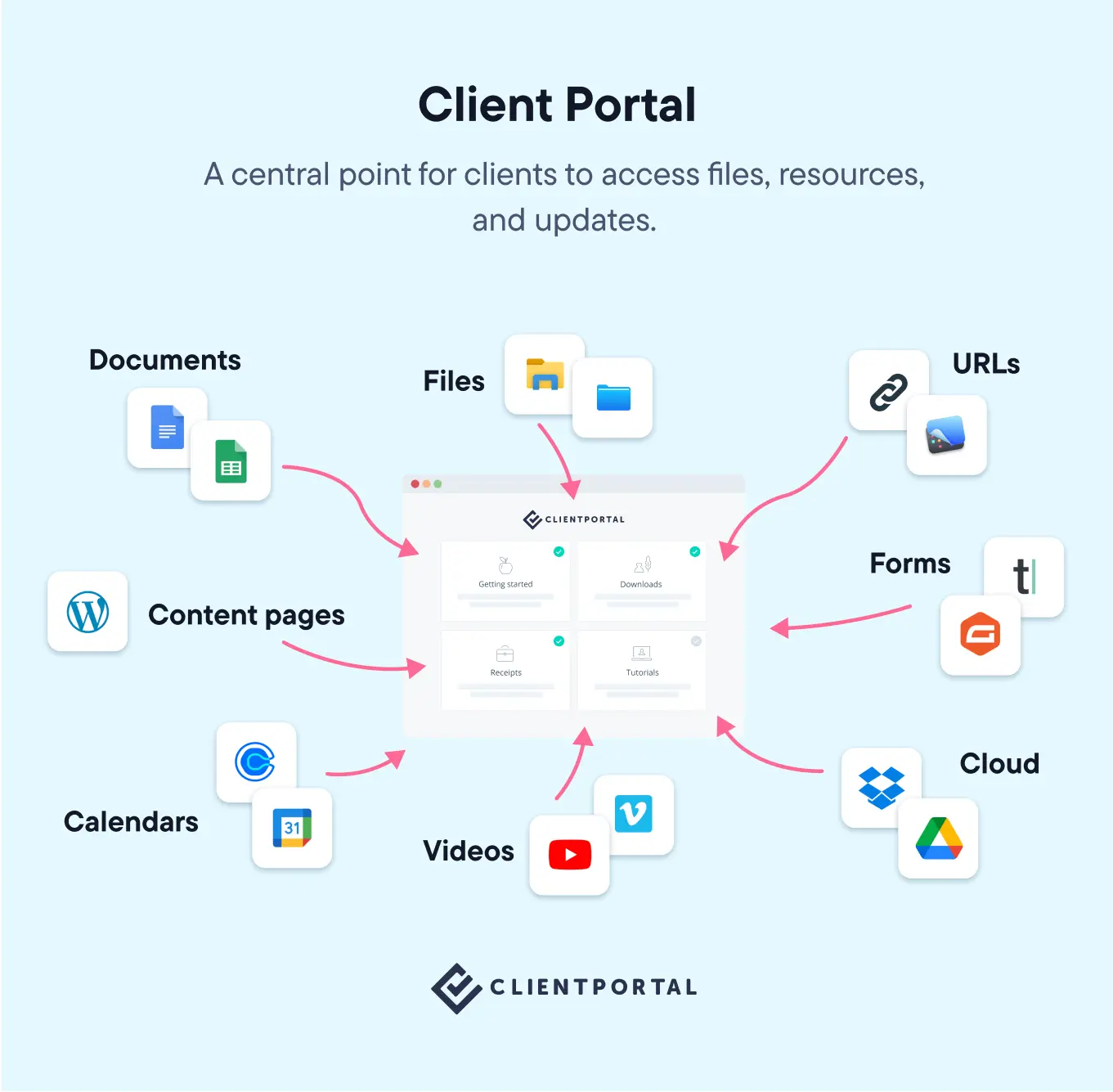
Your clients log into one place - their portal on your website. Everything they need is there:
- Links to your project management tool (if they need access)
- Embedded files from wherever you store them
- Links to invoices, proposals, Google Docs
- Uploaded deliverables
- Any information specific to their project
You keep using whatever tools work best for you. Client Portal just gives your clients one organized, professional place to access everything.
Why this matters
For you: You're not replacing working tools or learning new software. You're just adding a simple layer that makes everything more organized for your clients.
For your clients: They don't need to remember six different logins or figure out where things are. Everything's in one place, branded to look like they're working with you, not with a random collection of third-party tools.
For your business: You're not locked into an ecosystem that might not grow with you. Each piece of your workflow can evolve independently.
Tools should do one thing well
This is the philosophy behind Client Portal: be brilliant at giving your clients an organized, professional place to access their project - and nothing else.
Not project management. Not invoicing. Not time tracking. Just a really good portal.
Because when tools try to do everything, they usually do nothing particularly well.
When they focus on one thing, they can be excellent at it.
Client Portal is excellent at being a portal. Everything else? Use whatever tools you already love.