Early in my freelancing career, I agreed to design a 4-page brochure. Simple enough. The brief was clear, the client was lovely, and I delivered the first draft on time.
They loved it. So much so that they wanted "just a couple of extra sections." And then a few more. By the time we were done, the brochure was eight pages long and I'd done double the work for the original fee.
That was my introduction to scope creep. It probably won't be yours, because if you've freelanced for more than about five minutes, you've already met it.
What scope creep actually is
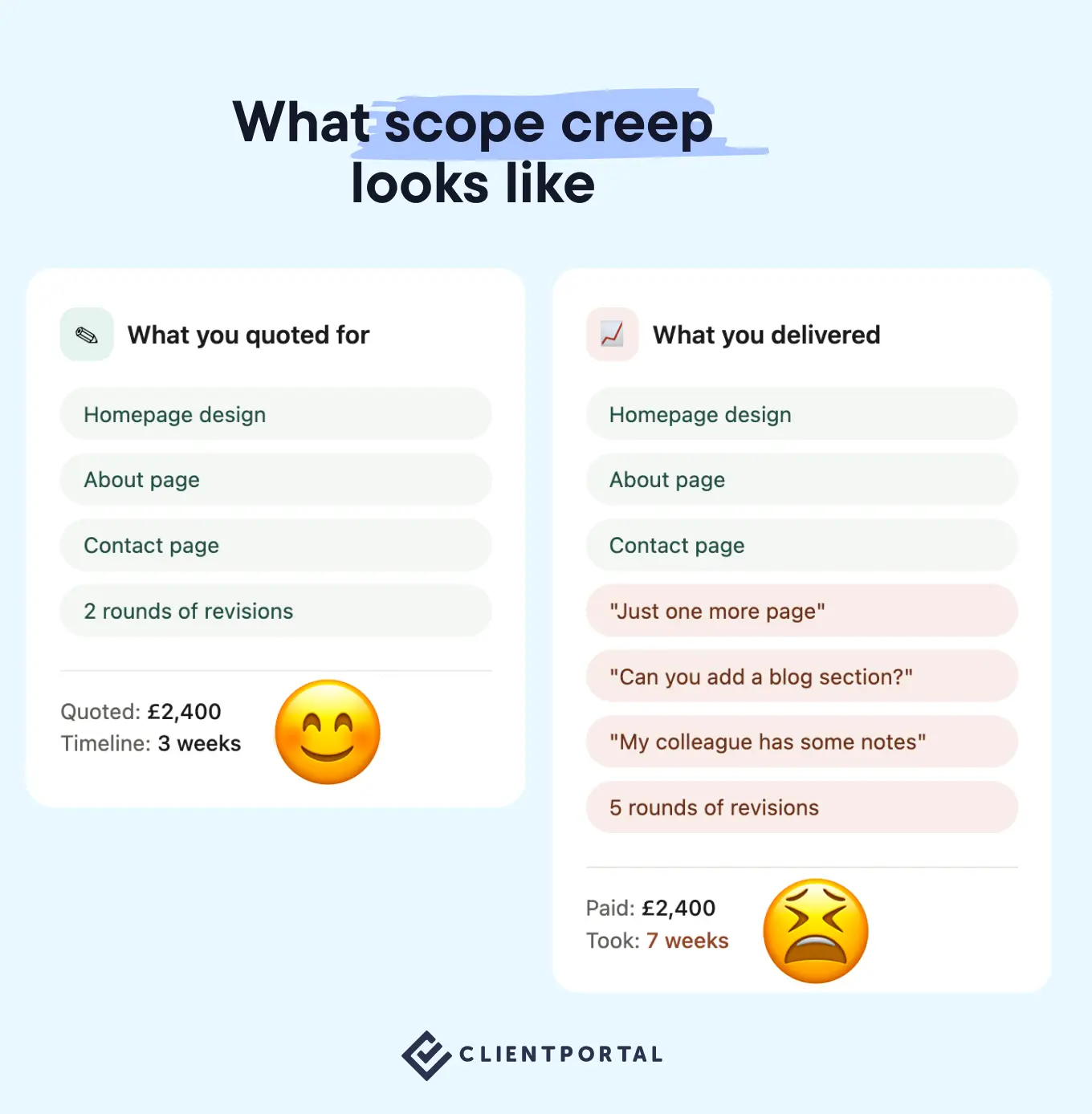
Scope creep is when a project quietly grows beyond what was originally agreed. It doesn't usually happen in one dramatic moment. It's more like a slow drift - a small request here, a "quick tweak" there - until one day you realise you're doing significantly more work than you quoted for.
It affects designers, developers, copywriters, consultants - basically anyone who works on projects with clients. And at some level, it's almost inevitable. Projects evolve. Clients have new ideas. That's normal.
The problem is when it goes unchecked. That's when it starts eating into your time, your profit, and eventually your enthusiasm for the project.
How it usually starts
Here's the thing about scope creep that makes it so tricky: the first request is always small. Really small. "Could you just..." small. And because it's small, you say yes. Of course you do. It would feel petty to push back on something that takes ten minutes.
But once you've said yes once, it gets harder to say no. The second request is a little bigger, but not much. The third is bigger still. By the time you're on the tenth request and the project has ballooned, you've lost the moment where you could have drawn a line. You set the precedent early on that extras were included, and now changing course feels awkward.
In my experience, scope creep rarely comes from malicious clients trying to squeeze free work out of you. More often, it's one of these:
- The brief was vague to begin with
The client says they want "a website" but hasn't really thought through what that means. Five pages? Fifteen? With e-commerce? Without? When the brief is fuzzy, the goalposts were never really set, so of course they move. - There's no process for handling changes
The client has a new idea mid-project (which is fair enough - projects spark ideas). But because nobody agreed upfront how changes would be handled, it just gets added to the pile. And then the next one does too. - The client doesn't understand what's involved
They ask you to "just move that logo a bit to the left." It sounds like a 2-minute job to them. They don't know it means opening the file, adjusting the layout, checking it doesn't break the grid on three other pages, exporting, and sending a new proof. To them, it's a tiny ask. To you, it's half an hour you're not being paid for. - Too many cooks arrive late
This one is particularly painful. You do the work, the client is happy, it's basically signed off. Then they send it to a handful of colleagues for "a quick look" and suddenly there are five new people with opinions, none of whom were involved in the original brief. Now you're fielding feedback from stakeholders who should have been in the room from the start.
None of these are villainous. They're just the normal messiness of working with other humans on projects. The trick is having systems in place so the messiness doesn't cost you money.
Preventing scope creep before the project starts
You can't prevent all scope creep. But you can reduce the worst of it by being clear upfront. Here's what's worked for me:
Get the brief right - most clients can't write one
This is something a lot of freelancers get frustrated about, but it's worth stepping back and thinking about. Your clients aren't experts at scoping projects. You are. Expecting them to send you a perfect brief is a bit like when I had building work done on my house - the builders kept asking me to tell them exactly what I wanted, but I'd never done a renovation before. I didn't know what they needed to know. I didn't even know the right questions to ask.
Your clients are in the same position. Instead of waiting for them to figure it out, run a proper discovery conversation and write the brief yourself. Then get them to sign off on it. You'll end up with a much clearer scope, and the client will feel like they're in good hands.
If you want to go further, consider making discovery a paid service. You're essentially scoping the project for them, which is genuinely valuable work. Charge for it.
Spell out what happens when the scope changes
Because it will. Somewhere in your proposal or agreement, include a short section that says: if the scope changes, here's what happens. Maybe it's an additional fee. Maybe it's a revised timeline. Whatever it is, decide it now so nobody's surprised later.
For example, if you're a designer, you might include something like: "This quote includes two rounds of revisions. Additional revision rounds are available at £X per round." It doesn't have to be aggressive or legalistic - just clear.
Limit revision rounds
This one's specifically for creative work, but it's worth mentioning. When clients know they have unlimited revisions, they tend to send feedback in dribs and drabs. One small note here, another tweak there. Each one takes you five minutes of actual work but twenty minutes of context-switching.
When you limit revisions to two or three rounds, clients tend to batch their feedback. They think more carefully about what they actually want to change, and the whole process is more efficient for everyone.
Use a client portal so everyone can see what was agreed
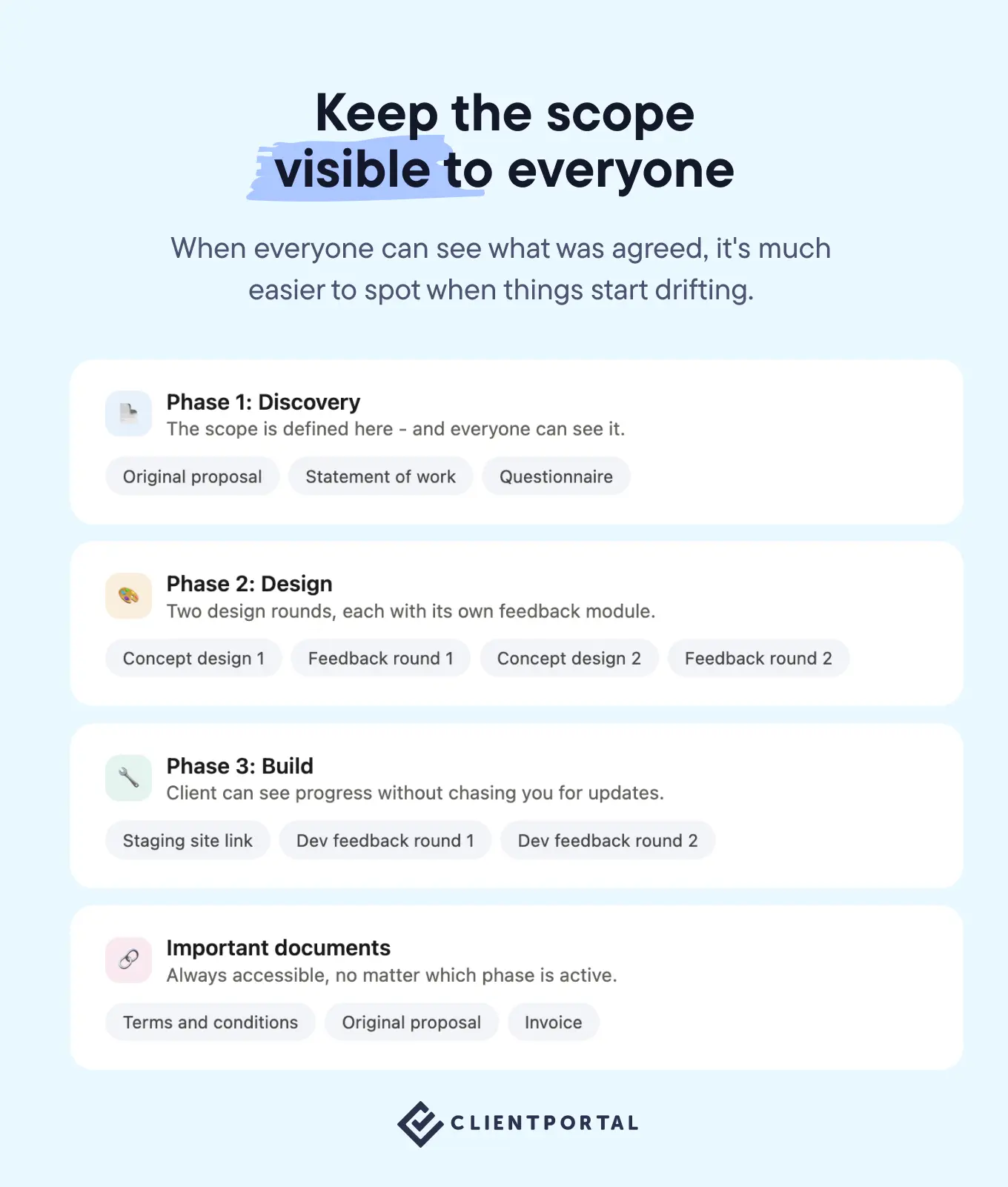
This is where having a single place for everything - the proposal, the brief, the timeline, the deliverables - really helps. When a client asks for something that wasn't in the original scope, you can both look at the same document and have an honest conversation about it.
It's much harder to have that conversation when the brief is buried in an email thread from three months ago.
And if you're wondering whether you still need a portal when you already use a project management tool - yes, and here's why.
What to do when scope creep happens anyway
Prevention is great. But sometimes, despite your best efforts, the scope starts creeping. Here's how to handle it without damaging the relationship.
1) Practise your response before you need it
This might sound odd, but hear me out. When scope creep starts getting out of hand, most of us get defensive. We start writing overly formal emails. We quote contract clauses. The tone shifts, and the client notices.
The fix is to decide what you're going to say before it happens. Not if it happens - when. Write yourself a template email or rehearse the phone call while you're in a good mood. Something like:
"That's a great idea - I think it'd really improve the project. It's a bit beyond what we originally scoped, so I can get that done for £X and have it ready by Friday. Want me to go ahead?"
When you've got a response ready that you know sounds positive and professional, you don't have to compose one on the fly while you're frustrated. You just use the one you prepared.
2) Assume good intent
When a client asks for something outside the scope, our instinct is often to assume they're trying to get something for free. But more often than not, they know the scope has changed. They're just waiting for you to tell them what it'll cost. So tell them.
3) Raise it early
The longer you leave it, the harder the conversation gets. If you spot scope creep in week two and say nothing until week eight, you've essentially been agreeing to the extra work for six weeks. At that point, the client will understandably feel blindsided when you mention additional costs.
The moment you notice the scope shifting, flag it. It doesn't have to be confrontational. A quick message is all you need.
4) Build a buffer into your quotes
Some freelancers add 10-20% to their quotes to account for the inevitable small scope changes. This gives you room to absorb the minor stuff without feeling resentful, and means you only need to have the awkward conversation when the changes are genuinely significant.
5) Learn from it
Every project teaches you something. If scope creep keeps happening in a particular way - maybe clients always ask for extra revision rounds, or they always want additional pages - build that into your process for next time. Update your proposal template, adjust your pricing, or add a clause to your agreement.

The real problem isn't bad clients - it's unclear expectations
I've been on both sides of this. As a freelancer, I dealt with scope creep constantly. Now, as someone who hires freelancers, I've probably been the one causing it a few times too.
The common thread is almost always the same: things weren't clear enough at the start. The brief was vague. The change process wasn't defined. The deliverables were floating around in emails where nobody could find them.
That's actually a big part of why I built Client Portal. Not to solve scope creep specifically, but to give everyone involved in a project one clear, organised place where they can see what's been agreed, what's been delivered, and what's still to come.
It won't stop your client from having a brilliant idea at 11pm that doubles the scope. But it does make it a lot easier to have an honest, professional conversation about it the next morning.
Quick checklist for your next project
Before you kick off your next client project, run through these:
- Is the scope clearly defined in writing (not just discussed on a call)?
- Has the client signed off on the scope?
- Does your agreement include what happens when the scope changes?
- Have you limited revision rounds?
- Is there one place where you and the client can both see the project status and deliverables?
- Have you built a realistic buffer into your quote?
- Do you have a positive, practised response ready for when extra requests come in?
If you can tick most of those, you're in good shape. Scope creep might still happen, but you'll be ready for it.